
Spinal Deformity Correction: Scoliosis & Kyphosis Treatment Explained

Spinal Deformity Correction: Scoliosis & Kyphosis Treatment Explained
Introduction
Spinal deformities can affect much more than a person’s appearance. Significant abnormal curvature of the spine may contribute to back pain, postural imbalance, reduced mobility, nerve-related symptoms, and, in severe cases, breathing difficulties. Two of the most commonly discussed spinal deformities are scoliosis and kyphosis.
Fortunately, modern spine care offers several treatment options ranging from observation, physiotherapy, and bracing to advanced spinal deformity correction surgery. Early diagnosis and specialist evaluation are important because treatment depends on the type and severity of the deformity, symptoms, age, and whether the curve is progressing.
What Is a Spinal Deformity?
A healthy spine naturally has gentle curves when viewed from the side. A spinal deformity develops when these curves become excessive or when the spine curves or rotates abnormally.
Spinal deformities may be present at birth, develop during childhood or adolescence, or occur later in adulthood due to degeneration, osteoporosis, prior surgery, injury, or other medical conditions.
The two major deformities include:
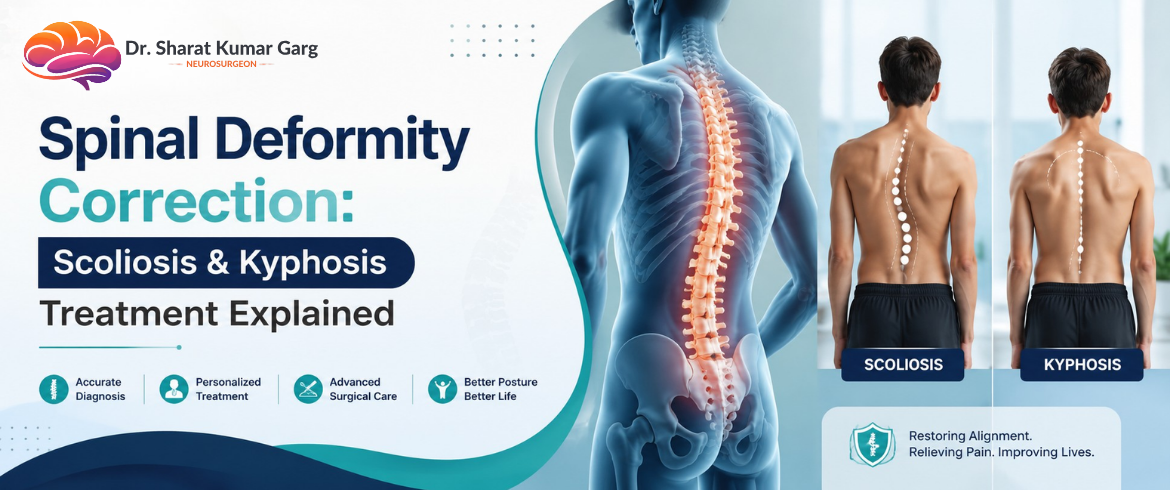
- Scoliosis: An abnormal sideways curvature of the spine, often accompanied by rotation of the vertebrae.
- Kyphosis: An excessive forward curvature that can produce an unusually rounded or hunched upper back.
Scoliosis is a three-dimensional spinal condition rather than simply a sideways bend.
Understanding Scoliosis
Scoliosis often develops during childhood or adolescence, although adults can also experience it. The most common form in young people is idiopathic scoliosis, meaning that its exact cause is unknown. Other forms may be congenital or associated with neuromuscular disorders.
Common signs of scoliosis include:
- Uneven shoulders
- One shoulder blade appearing more prominent
- Uneven waist or hips
- Leaning toward one side
- Visible C- or S-shaped spinal curvature
- Rib prominence when bending forward
- Back discomfort in some patients
Small curves may cause few noticeable problems, while larger or progressive curves can significantly affect posture and spinal balance.
Anyone noticing progressive spinal asymmetry should consider an assessment by an experienced spine specialist or the best neurosurgeon in Noida to determine the cause, severity, and appropriate treatment strategy.
Understanding Kyphosis
The thoracic or upper spine normally has a degree of forward curvature. Kyphosis becomes a clinical concern when this curvature is excessive, resulting in an abnormally rounded upper back.
Several forms of kyphosis exist, including postural kyphosis, Scheuermann’s kyphosis, and congenital kyphosis. Postural kyphosis is often flexible, whereas structural forms may be more rigid.
Possible symptoms include:
- Rounded shoulders
- Visible hump or rounded upper back
- Back pain
- Fatigue after prolonged sitting or standing
- Spinal stiffness
- Tightness in the muscles behind the thighs
- Difficulty maintaining an upright posture
Severe progressive kyphosis can occasionally lead to neurological problems or breathing difficulties.
How Are Scoliosis and Kyphosis Diagnosed?
Diagnosis usually begins with a detailed medical history and physical examination. The specialist evaluates posture, shoulder and pelvic alignment, spinal flexibility, walking pattern, muscle strength, sensation, and neurological function.
The patient may also be asked to bend forward so that spinal asymmetry or rib prominence can be assessed.
Imaging Tests
X-rays: Standing spinal X-rays help doctors identify the location and magnitude of the curve and evaluate overall spinal alignment.
MRI: MRI may be advised when neurological symptoms are present or when doctors need detailed images of the spinal cord, nerves, discs, and surrounding soft tissues.
CT Scan: CT imaging may occasionally be used to obtain detailed information about complex bony anatomy, particularly when surgical planning is required.
A thorough evaluation by the best neurosurgeon in Noida can help determine whether the deformity requires monitoring, conservative treatment, or surgical correction.
Non-Surgical Treatment for Spinal Deformities
Not every patient with scoliosis or kyphosis requires surgery. Treatment is individualized according to age, symptoms, curve severity, skeletal maturity, and the likelihood of progression.
Observation
Mild curves may simply require periodic examinations and imaging. Monitoring is particularly important during growth because some spinal curves can progress rapidly during adolescence.
Physiotherapy and Exercise
A supervised rehabilitation program may help improve:
- Core strength
- Posture
- Flexibility
- Muscle endurance
- Functional movement
- Back discomfort
Exercise can be valuable for symptom management and general conditioning, although its ability to correct a structural curve is limited.
Bracing
Bracing is most commonly considered in selected growing children and adolescents. Its main purpose is usually to reduce the risk of further curve progression rather than permanently straighten the spine.
Observation, bracing, and surgery are among the established management approaches for scoliosis depending on factors such as growth and curve severity.
When Is Spinal Deformity Correction Surgery Needed?
Surgery may be considered when the deformity is severe, continues to progress, causes significant symptoms, produces neurological problems, or substantially affects spinal balance and everyday function.
Possible reasons for surgery include:
- Severe or progressive curvature
- Persistent pain despite conservative treatment
- Significant postural imbalance
- Nerve or spinal cord compression
- Weakness or numbness
- Difficulty walking
- Major functional limitations
- Breathing problems associated with severe deformity
There is no single curve measurement that determines surgery for every patient. Age, symptoms, growth potential, deformity type, overall alignment, and neurological findings must all be considered.
Patients with complex or progressive deformities can consult the best neurosurgeon in Noida for individualized assessment and discussion of the potential benefits and risks of surgery.
How Is Spinal Deformity Correction Surgery Performed?
The primary goal of surgery is not simply to make an X-ray look straight. Treatment aims to achieve a safer, more balanced spinal alignment while protecting the spinal cord and nerves.
One commonly used technique is spinal fusion with instrumentation.
During surgery, screws and rods may be placed into selected vertebrae to stabilize and gradually reposition the spine. Bone graft material is then used to encourage the treated vertebrae to fuse into a stable structure. Spinal fusion is also commonly used in surgical treatment of significant kyphosis.
Depending on the deformity, surgeons may use additional corrective techniques. The exact procedure varies significantly from patient to patient.
In selected conditions, minimally invasive techniques may also be considered. Such approaches are designed to reduce disruption of surrounding muscles and soft tissues compared with traditional open surgery, although they are not suitable for every complex deformity.
Recovery After Spinal Deformity Correction
Recovery depends on the complexity of surgery, the number of spinal levels treated, the patient’s age, and overall health.
Initially, patients are monitored for pain control, neurological function, wound healing, and mobility. Walking is generally introduced according to the surgeon’s recommendations.
During the following weeks and months, patients may gradually return to routine activities. Physiotherapy may be advised to improve mobility, strength, and functional independence.
Spinal fusion itself takes time to become solid, so patients should carefully follow restrictions regarding lifting, bending, exercise, work, and sports.
Benefits and Risks of Spinal Deformity Surgery
Successful treatment may improve spinal alignment, prevent further progression, relieve selected symptoms, and improve overall function and quality of life.
However, spinal deformity correction is a major procedure and may carry risks such as:
- Infection
- Bleeding
- Blood clots
- Nerve or spinal cord injury
- Implant-related problems
- Failure of the bones to fuse completely
- Need for additional surgery
Patients should discuss expected outcomes and individual risks in detail before deciding on treatment.
Why Early Evaluation Matters
Spinal deformities do not always require surgery, but progressive curves should not be ignored. Early diagnosis provides an opportunity to monitor changes and use conservative treatment when appropriate.
Children undergoing rapid growth and adults experiencing increasing deformity, persistent pain, weakness, numbness, walking difficulties, or bowel or bladder changes should receive timely medical assessment.
Consulting the best neurosurgeon in Noida can help patients understand their spinal condition, available treatment options, and whether conservative care or deformity correction surgery is appropriate.
Conclusion
Scoliosis and kyphosis can range from mild postural abnormalities to complex structural deformities. While mild cases may only require monitoring, physiotherapy, or bracing, progressive and severe deformities may need surgical correction.
Modern spinal deformity treatment focuses on achieving safe spinal balance, protecting neurological function, controlling symptoms, and helping patients maintain an active life. An accurate diagnosis and individualized treatment plan remain essential for achieving the best possible outcome.
Frequently Asked Questions
1. Can scoliosis be treated without surgery?
Yes. Mild or moderate scoliosis may be managed with monitoring or bracing, depending on age, growth, and curve progression.
2. Is kyphosis always caused by poor posture?
No. Some cases are postural, while others result from structural, congenital, or developmental abnormalities.
3. When is surgery required for scoliosis?
Surgery may be considered for severe or progressive curves, significant imbalance, neurological problems, or major functional limitations.
4. Can adults undergo spinal deformity correction?
Yes. Adults with symptomatic or progressive spinal deformities may be candidates after a comprehensive evaluation.
5. How long does recovery take after deformity surgery?
Recovery varies depending on the procedure and patient, with gradual improvement typically occurring over several weeks to months.

